
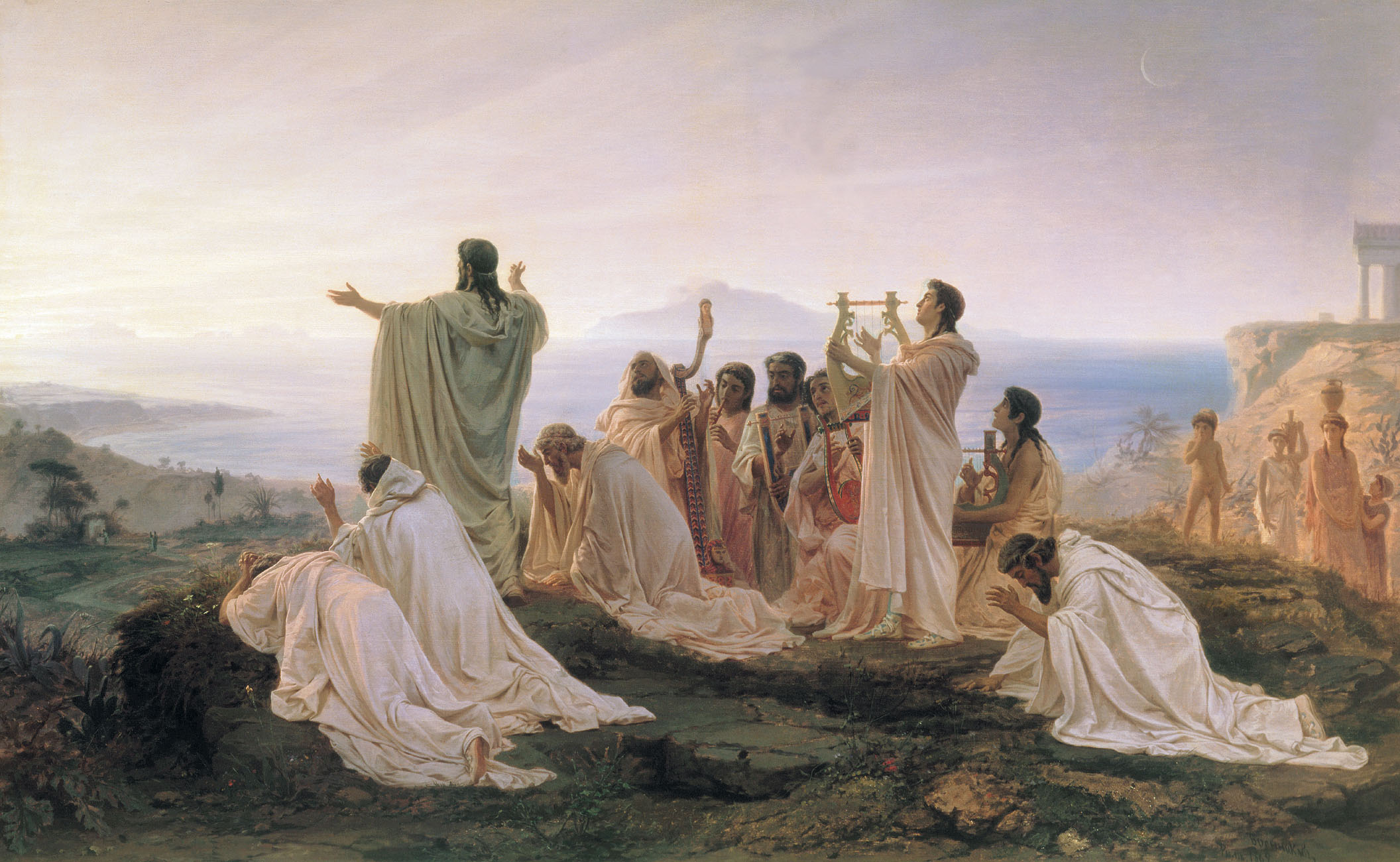
About Pythagoras
Introduction
Pythagoras was born on the Greek island of Samos and lived around 500 BC. He visited Egypt and, it is assumed, Babylon. He founded a school on Samos and, after the Persian occupation, settled in Crotone in southern Italy, where he also founded the Pythagorean brotherhood.
Pythagoras was a central figure in the transition from Antiquity to the Classical period. In the world of Antiquity, the gods shaped reality; there was a strong attachment to the physical world, to coming into being and passing away, to life and death. In the Classical worldview, people have a personal, moral relationship with the gods (or god). Divinity is found within the soul, and natural phenomena are explained through the notion of causality.
Our current view of the world is based on this Classical worldview, which is itself a product of the philosophy of Pythagoras and the other natural philosophers, and which is still the source of many modern developments. This underlines the importance of reading and interpreting the original sources in their proper context. These ancient texts should not be read as prose or poetry; they should be read with the Pythagorean worldview in mind.
Ethics
Pythagorean moral philosophy is related to Orphic mysticism. It is difficult to distinguish which elements can be ascribed to the Orphics and which to the Pythagoreans. Central to this ethical philosophy was the doctrine of metempsychosis, the transmigration of the soul. Here we find a certain similarity to Hinduism. Belief in metempsychosis also entailed abstinence from animal products. The Pythagorean ethics are set out in the Golden Verses.
The Golden Verses
These verses outline a way of life that leads to the divinity of the soul, and were probably written by one of Pythagoras’ followers. The Golden Verses were first put into practice in the Pythagorean brotherhood in southern Italy, and later in the Pythagorean communities that followed.
- Honor the immortal gods first, in the order appointed by custom,
- and revere your oath. Pay reverence next to the noble heroes
- and the spirits of the dead by performing the prescribed rites.
- Honor your parents as well as their closest relatives.
- Among others, choose as your friend him who excels in virtue.
- Yield to his gentle words and useful actions,
- and do not hate your friend for a small fault,
- for as long as you are able to do so. For ability lives near necessity.
- Know the above then, and accustom yourself to be master of the following:
- first of all, of your stomach, of sleep, of lust,
- and of anger. Never do anything shameful, neither with somebody else,
- nor on your own. Feel shame before yourself most of all.
- Furthermore, practice justice both in deed and in word,
- and accustom yourself not to be without thought about anything,
- but know that death has been destined for all,
- and that property is wont to be acquired now, tomorrow lost.
- But whatever pains mortals suffer through the divine workings of fate,
- whatever lot you have, bear it and do not be angry.
- It is fitting that it be healed as far as possible, and say to yourself as follows:
- Fate does not give very many of these sufferings to the good.
- Many words assail human beings, bad as well as good.
- Do not be dumbfounded by them, nor allow
- yourself to be hindered. If in fact something false is said,
- withdraw amiably. Let what I shall tell you, however, be accomplished in every instance:
- Let no one persuade you either by word or even by deed
- to do or to say whatever is not best for you.
- Deliberate before the deed, lest foolish things result from it.
- It is typical of a worthless man indeed to do or to say senseless things.
- But bring that to completion which will not distress you afterwards.
- Do not do even one thing of what you do not understand, but learn
- what is necessary, and thus you will lead a most enjoyable life.
- You should not be careless about your physical health,
- but you should practice due measure in drinking, eating, and physical exercises.
- By due measure I mean that which will not distress you.
- Become accustomed to have a pure way of life, not an enervated one,
- and guard against doing the kind of thing that incurs envy.
- Do not spend money at the wrong time like someone ignorant of what is good,
- nor be tight-fisted. Due measure is in everything the best.
- Do that which will not harm you, and take thought before the deed.
- Do not welcome sleep upon your soft eyes
- before you have reviewed each of the day’s deeds three times:
- “Where have I transgressed? What have I accomplished? What duty have I neglected?”
- Beginning from the first one go through them in detail, and then,
- if you have brought about worthless things, reprimand yourself, but if you have achieved good things, be glad.
- Work hard at this, meditate on this, you should passionately desire this;
- this will put you in the footsteps of divine Virtue,
- yes, by him who imparted to our soul the tetraktys,
- fount of ever-flowing nature. But to work!
- and pray to the gods to grant the fulfillment. When you have mastered these things,
- you will come to know the essence of immortal gods and mortal men,
- how it pervades each thing and how each thing is ruled [by it].
- You will come to know, as is right, nature, alike in everything,
- so that you do not expect what is not to be expected, nor anything escape your notice.
- You will come to know that the miseries men suffer are self-incurred,
- the wretched people, who do not see the good even though it is near,
- nor do they hear it. Few understand the deliverance from their troubles.
- Such is the fate that harms their minds: like tumbling stones
- they are borne hither and thither, suffering endless miseries.
- For a deadly innate companion, Discord, has injured them
- unawares. This one must not promote, but withdraw and flee from it.
- Father Zeus, you would surely deliver all from many evils,
- if you would show all what kind of daimon they have.
- But take courage, for mortals have a divine origin,
- to whom Nature displays and shows each sacred object.
- If you have any share in this, you will master what I command you by means of a thorough cure,
- and you will save your soul from these sufferings.
- But keep away from food that we have mentioned in Purifications
- and in Deliverance of the Soul, with discernment, and consider each thing
- by putting the excellent faculty of judgment in control as charioteer.
- Then, if you leave the body behind and go to the free aither,
- you will be immortal, an undying god, no longer mortal.
Translated by Johan C. Thom. See also Newsletter 14.
Vegetarianism
The Pythagoreans led ascetic lives. Respect for life was essential: vegetarianism was the norm, and the sacrifice of animals to the gods was abolished. Pythagoras can thus be regarded as the founder of vegetarianism in Europe. Until the second half of the 19th century, anyone who abstained from meat and animal products was known as a Pythagorean; only later was the word vegetarian introduced. Vegetarianism became more or less synonymous with the Pythagorean way of life, although the latter encompasses much more than a meat-free diet.
Astronomy, music and number theory
The Pythagoreans also made great contributions to astronomy. They assumed the earth was spherical, both on the basis of observation and because, in their view, the sphere was the most perfect shape and fitted their system best. By expressing the distances between the celestial bodies in whole and half tones, Pythagoras arrived at his (sevenfold) Harmony of the Spheres. The cosmic scale has a distinctive root note, which we never notice because there is never a moment when we do not hear it. It is said that Pythagoras himself could hear it.
The Pythagoreans were highly active in music. They discovered that there is a ratio between the length of a string on a sounding board and its pitch. This led to an understanding of quantitative proportions. The Pythagoreans were so impressed by the significance of number and numerical proportion (harmony) that they declared number to be the basis of all existence, the essence of all things. The well-known theorem about right-angled triangles that bears Pythagoras’ name was already known long before his time.
The Pythagorean Ecphantus taught that the earth rotates on its own axis. Later, some planets were thought to move around the sun, and Aristarchus of Samos (around 280 BC) placed the sun at the centre, with the earth and the planets revolving around it. It was not until the 15th and 16th centuries that Copernicus developed this idea further.